Sodium-Potassium pumps
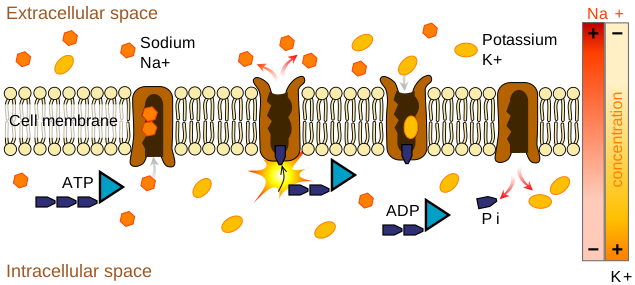
Active transport is responsible for cells containing relatively high concentrations of ions but low concentrations of sodium ions. The mechanism responsible for this is the sodium-potassium pump, which moves these two ions in opposite directions across the plasma membrane. This was investigated by following the passage of radioactively labeled ions across the plasma membrane of certain cells. It was found that the concentrations of sodium and potassium ions on the two other sides of the membrane are interdependent, suggesting that the same carrier transports both ions. It is now known that the carrier is an ATP-ase and that it pumps three sodium ions out of the cell for every two potassium ions pumped in.Function
The Na+/K+-ATPase helps maintain resting potential, avail transport, and regulate cellular volume.[citation needed] It also functions as signal transducer/integrator to regulate MAPK pathway, ROS, as well as intracellular calcium. For most animal cells, the Na+/K+-ATPase is responsible for 1/3 of the cell's energy expenditure. For neurons, the Na+/K+-ATPase is responsible for 2/3 of the cell's energy expenditure. [citation needed]Functioning as signal transducer
Within the last decade, many independent labs have demonstrated that, in addition to the classical ion transporting, this membrane protein can also relay extracellular ouabain-binding signalling into the cell through regulation of protein tyrosine phosphorylation. The downstream signals through ouabain-triggered protein phosphorylation events include to activate the mitogen-activated protein kinase (MAPK) signal cascades, mitochondrial reactive oxygen species (ROS) production, as well as activation of phospholipase C (PLC) and inositol triphosphate (IP3) receptor (IP3R) in different intracellular compartments.[1]Protein-protein interactions play very important role in Na+-K+ pump-mediated signal transduction. For example, Na+-K+ pump interacts directly with Src, a non-receptor tyrosine kinase, to form a signaling receptor complex.[2] Src kinase is inhibited by Na+-K+ pump, while, upon ouabain binding, Src kinase domain will be released and then activated. Based on this scenario, NaKtide, a peptide Src inhibitor derived from Na+-K+ pump, was developed as a functional ouabain antagonist.[3] Na+-K+ pump also interacts with ankyrin, IP3R, PI3K, PLC-gamma and cofilin.[4]
Mechanism
- The pump, with bound ATP, binds 3 intracellular Na+ ions.
- ATP is hydrolyzed, leading to phosphorylation of the pump at a highly conserved aspartate residue and subsequent release of ADP.[citation needed]
- A conformational change in the pump exposes the Na+ ions to the outside. The phosphorylated form of the pump has a low affinity for Na+ ions, so they are released.[citation needed]
- The pump binds 2 extracellular K+ ions. This causes the dephosphorylation of the pump, reverting it to its previous conformational state, transporting the K+ ions into the cell.[citation needed]
- The unphosphorylated form of the pump has a higher affinity for Na+ ions than K+ ions, so the two bound K+ ions are released. ATP binds, and the process starts again.


No comments:
Post a Comment