Saturday, October 22, 2011

Hydride Shift
   
                  Slide2 (2).jpg
GREEN (Cl) = nucleophile     BLUE (OH) = leaving group     ORANGE (H) = hydride shift proton         RED(H) =remaining proton

Hydride Shift

         Slide2 (2).jpg

      
GREEN (Cl) = nucleophile     BLUE (OH) = leaving group     ORANGE (H) = hydride shift           proton  RED(H) = remaining proton

DIWALI WISHES

            SEARCHED MANY GARDENS

                          I Searched Many Gardens
                         To Select A Flower To Give U
                         As My Diwali Gift.
                         But, I Didn't Find Any Flower
                         Beautiful Than Ur Smile. 


                         So Keep smiling. 

                                * Happy Diwali *


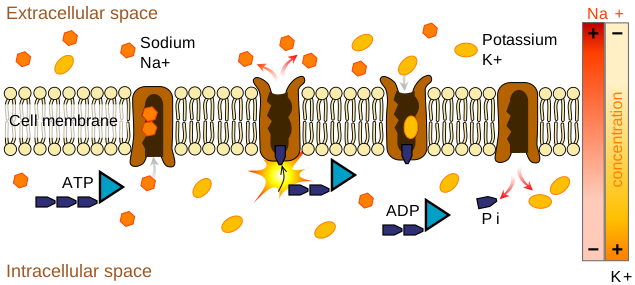
Mechanism of Na/K pump


Sodium-Potassium pumps

Active transport is responsible for cells containing relatively high concentrations of ions but low concentrations of sodium ions. The mechanism responsible for this is the sodium-potassium pump, which moves these two ions in opposite directions across the plasma membrane. This was investigated by following the passage of radioactively labeled ions across the plasma membrane of certain cells. It was found that the concentrations of sodium and potassium ions on the two other sides of the membrane are interdependent, suggesting that the same carrier transports both ions. It is now known that the carrier is an ATP-ase and that it pumps three sodium ions out of the cell for every two potassium ions pumped in.

Function

The Na+/K+-ATPase helps maintain resting potential, avail transport, and regulate cellular volume.[citation needed] It also functions as signal transducer/integrator to regulate MAPK pathway, ROS, as well as intracellular calcium. For most animal cells, the Na+/K+-ATPase is responsible for 1/3 of the cell's energy expenditure. For neurons, the Na+/K+-ATPase is responsible for 2/3 of the cell's energy expenditure. [citation needed]


Functioning as signal transducer

Within the last decade, many independent labs have demonstrated that, in addition to the classical ion transporting, this membrane protein can also relay extracellular ouabain-binding signalling into the cell through regulation of protein tyrosine phosphorylation. The downstream signals through ouabain-triggered protein phosphorylation events include to activate the mitogen-activated protein kinase (MAPK) signal cascades, mitochondrial reactive oxygen species (ROS) production, as well as activation of phospholipase C (PLC) and inositol triphosphate (IP3) receptor (IP3R) in different intracellular compartments.[1]
Protein-protein interactions play very important role in Na+-K+ pump-mediated signal transduction. For example, Na+-K+ pump interacts directly with Src, a non-receptor tyrosine kinase, to form a signaling receptor complex.[2] Src kinase is inhibited by Na+-K+ pump, while, upon ouabain binding, Src kinase domain will be released and then activated. Based on this scenario, NaKtide, a peptide Src inhibitor derived from Na+-K+ pump, was developed as a functional ouabain antagonist.[3] Na+-K+ pump also interacts with ankyrin, IP3R, PI3K, PLC-gamma and cofilin.[4]

 Mechanism


  • The pump, with bound ATP, binds 3 intracellular Na+ ions.
  • ATP is hydrolyzed, leading to phosphorylation of the pump at a highly conserved aspartate residue and subsequent release of ADP.[citation needed]
  • A conformational change in the pump exposes the Na+ ions to the outside. The phosphorylated form of the pump has a low affinity for Na+ ions, so they are released.[citation needed]
  • The pump binds 2 extracellular K+ ions. This causes the dephosphorylation of the pump, reverting it to its previous conformational state, transporting the K+ ions into the cell.[citation needed]
  • The unphosphorylated form of the pump has a higher affinity for Na+ ions than K+ ions, so the two bound K+ ions are released. ATP binds, and the process starts again.

Saturday, September 3, 2011

SPIRO COMPOUNDS

SP-1 Compounds with only monocyclic ring components
SP-1.1 Monospiro hydrocarbons with two monocyclic rings are named by the prefix spiro before a von Baeyer descriptor (indicating the numbers of carbon atoms linked to the spiro atom in each ring in ascending order and separated by a full stop) placed in square brackets and then the name of the parent hydrocarbon indicating the total number of skeletal atoms e.g. spiro[4.4]nonane.
SP-1.2 Monospiro hydrocarbons with two monocyclic rings are numbered consecutively starting in the smaller ring at an atom next to the spiro atom, proceeding around the smaller ring back to the spiro atom and then round the second ring.
Example:


spiro[4.5]decane
not spiro[5.4]decane
SP-1.3 Heteroatoms are indicated by replacement prefixes (rules B-4.2, B-6.1, 5 and rules R-1.2.2.1 and R-9.3, ref 6) and unsaturation is indicated in the usual way (rule A-11.3, ; R-3.1.1, ) by the endings ene, diene, etc.
Examples:


8-azaspiro[4.5]dec-2-ene

spiro[4.4]nona-2,7-diene

3,9-diazaspiro[5.5]undecane
SP-1.4 Unbranched polyspiro hydrocarbons composed of only monocyclic rings are named using dispiro-, trispiro-, etc. indicating the total number of spiro atoms present and the name of the parent hydrocarbon corresponding

NAMING OF BICYLO ORGANIC COMPOUNDS

Bridged Hydrocarbons

Rule A-1. Bicyclic Systems
1.1 - Saturated alicyclic hydrocarbon systems consisting of two rings only, having two or more atoms in common, take the name of an open chain hydrocarbon containing the same total number of carbon atoms preceded by the prefix "bicyclo-". The number of carbon atoms in each of the three bridges connecting the two tertiary carbon atoms is indicated in brackets in descending order.

Examples to Rule A-1.1


1.2 - The system is numbered commencing with one of the bridgeheads, numbering proceeding by the longest possible path to the second bridgehead; numbering is then continued from this atom by the longer unnumbered path back to the first bridgehead and is completed by the shortest path from the atom next to the first bridgehead.

Examples to Rule A-1.2


1.3 - Unsaturated hydrocarbons are named in accordance with the principles set forth in Rule A-11.3 When after applying Rule A-1.2 a choice in numbering remains unsaturation is given the lowest numbers.

Examples to Rule A-1.3


(See Rule A-.1 for double locants)
1.4 - Radicals derived from bridged hydrocarbons are named in accordance with the principles set forth in Rule A-11 The numbering of the hydrocarbon is retained and the point or points of attachment are given numbers as low as is consistent with the fixed numbering of the saturated hydrocarbon.

Examples to Rule A-1.4


Wednesday, August 24, 2011

CARBOCATION REARRANGEMENTS

Hydride Shift   

Slide2 (2).jpg
GREEN (Cl) = nucleophile     BLUE (OH) = leaving group     ORANGE (H) = hydride shift proton                                                  RED(H) = remaining proton
                  

Hydration of Alkenes: Hydride Shift

In a more complex case, when alkenes undergo hydration, we also observe hydride shift. Below is the reaction of 3-methyl-1-butene with H3O+ that furnishes to make 2-methyl-2-butanol
                                              Slide5 (1).jpg                                   
 
We see this mechanism below:
Slide6 (1).jpg
    Alkyl Shift

Alkyl Shift acts very similarily to that of hydride shift. Instead of the proton (H) that shifts with the nucleophile, we see an alkyl group that shifts with the nucleophile instead. The shifting group carries its electron pair with it to furnish a bond to the neighboring or adjacent carbocation.

We see alkyl shift from a secondary carbocation to tertiary carbocation in SN1 reactions:
Slide7.jpg

#2, on the other hand, we can say that it undergoes a concerted mechanism. In short, this means that everything happens in one step. This is because primary carbocations cannot be an intermediate and they are relatively difficult processes since they require higher temperatures and longer reaction times. After protonating the alcohol substrate to form the alkyloxonium ion, the water must leave at the same time as the alkyl group shifts from the adjacent carbon to skip the formation of the unstable primary carbocation.
     Slide8.jpg              

Problems

 Slide9.jpg
Slide10.jpg

Answers to Practice Problems

Slide11.jpg
Slide12 (1).jpg
  

Tuesday, August 23, 2011

ENZYME SUBSTRATE MECHANISM

Michaelis–Menten kinetics
Saturation curve for an enzyme showing the relation between the concentration of substrate and rate.
Single-substrate mechanism for an enzyme reaction. k1, k-1 and k2 are the rate constants for the individual steps.
As enzyme-catalysed reactions are saturable, their rate of catalysis does not show a linear response to increasing substrate. If the initial rate of the reaction is measured over a range of substrate concentrations (denoted as [S]), the reaction rate (v) increases as [S] increases, as shown on the right. However, as [S] gets higher, the enzyme becomes saturated with substrate and the rate reaches Vmax, the enzyme's maximum rate.
The Michaelis–Menten kinetic model of a single-substrate reaction is shown on the right. There is an initial bimolecular reaction between the enzyme E and substrate S to form the enzyme–substrate complex ES. Although the enzymatic mechanism for the unimolecular reaction   ES \overset{k_{cat}} {\longrightarrow} E + P can be quite complex, there is typically one rate-determining enzymatic step that allows this reaction to be modelled as a single catalytic step with an apparent unimolecular rate constant kcat. If the reaction path proceeds over one or several intermediates, kcat will be a function of several elementary rate constants, whereas in the simplest case of a single elementary reaction (e.g. no intermediates) it will be identical to the elementary unimolecular rate constant k2. The apparent unimolecular rate constant kcat is also called turnover number and denotes the maximum number of enzymatic reactions catalysed per second.
The Michaelis–Menten equation[9] describes how the (initial) reaction rate v0 depends on the position of the substrate-binding equilibrium and the rate constant k2.
 v_0 = \frac{V_\max[\mbox{S}]}{K_M + [\mbox{S}]}     (Michaelis–Menten equation)
with the constants
 \begin{align} 
K_M \ &\stackrel{\mathrm{def}}{=}\  \frac{k_{2} + k_{-1}}{k_{1}} \approx K_D\\
V_\max \ &\stackrel{\mathrm{def}}{=}\   k_{cat}{[}E{]}_{tot}
\end{align}
This Michaelis–Menten equation is the basis for most single-substrate enzyme kinetics. Two crucial assumptions underlie this equation (apart from the general assumption about the mechanism only involving no intermediate or product inhibition, and there is no allostericity or cooperativity). The first assumption is the so called quasi-steady-state assumption (or pseudo-steady-state hypothesis), namely that the concentration of the substrate-bound enzyme (and hence also the unbound enzyme) changes much more slowly than those of the product and substrate and thus the change over time of the complex can be set to zero  d{[}ES{]}/{dt}  \; \overset{!} = \;0 . The second assumption is that the total enzyme concentration does not change over time, thus  {[}E{]}_\text{tot} = {[}E{]} + {[}ES{]}  \; \overset{!} = \; \text{const} . A complete derivation can be found here.
The Michaelis constant KM is experimentally defined as the concentration at which the rate of the enzyme reaction is half Vmax, which can be verified by substituting [S] = Km into the Michaelis–Menten equation and can also be seen graphically. If the rate-determining enzymatic step is slow compared to substrate dissociation (k_2 \ll k_{-1} ), the Michaelis constant KM is roughly the dissociation constant KD of the ES complex.
If [S] is small compared to KM then the term [S] / (K_M + [S]) \approx [S] / K_M and also very little ES complex is formed, thus [E]_0 \approx [E]. Therefore, the rate of product formation is
v_0 \approx  \frac{k_{cat}}{K_M} [E] [S] \qquad \qquad \text{if } [S] \ll K_M
Thus the product formation rate depends on the enzyme concentration as well as on the substrate concentration, the equation resembles a bimolecular reaction with a corresponding pseudo-second order rate constant k2 / KM. This constant is a measure of catalytic efficiency. The most efficient enzymes reach a k2 / KM in the range of 108 - 1010 M−1 s−1. These enzymes are so efficient they effectively catalyse a reaction each time they encounter a substrate molecule and have thus reached an upper theoretical limit for efficiency (diffusion limit); these enzymes have often been termed perfect enzymes.[10]       


Wednesday, August 17, 2011

OXIDATION -REDUCTION


Oxidation and reduction in terms of electron transfer
This is easily the most important use of the terms oxidation and reduction at A' level.
Definitions

  • Oxidation is loss of electrons.
  • Reduction is gain of electrons.
It is essential that you remember these definitions. There is a very easy way to do this. As long as you remember that you are talking about electron transfer:
A simple example
The equation shows a simple redox reaction which can obviously be described in terms of oxygen transfer.

Copper(II) oxide and magnesium oxide are both ionic. The metals obviously aren't. If you rewrite this as an ionic equation, it turns out that the oxide ions are spectator ions and you are left with:

Standard Reduction Potential

Reduction potential is used to calculate the standard electrode potential (Eocell).
This is the equation most commonly seen in textbooks:
Eocell = Eored + Eoox .
where: Eocell is the standard electrode potential (in volts).
Eored is standard reduction potential of the reducing agent.
Eoox (standard oxidation potential) is negative of the standard reduction potential of the oxidizing agent.
though the following equation is generally more useful as one is usually only given reduction potentials, not oxidation potentials:


Eocell = Eored - Eoox .
or equivalently:
Eocell = Eocathode - Eoanode
where:
Eocell is the standard electrode potential (in volts).
Eored (Eocathode) is standard reduction potential of the reducing agent.
 Eoox (Eoanode) is the standard reduction potential of the oxidizing agent.