Hydride Shift
.jpg)
GREEN (Cl) = nucleophile BLUE (OH) = leaving group ORANGE (H) = hydride shift proton RED(H) =remaining proton


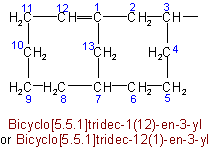
Examples to Rule A-1.11.2 - The system is numbered commencing with one of the bridgeheads, numbering proceeding by the longest possible path to the second bridgehead; numbering is then continued from this atom by the longer unnumbered path back to the first bridgehead and is completed by the shortest path from the atom next to the first bridgehead.
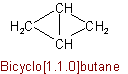
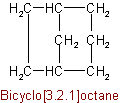
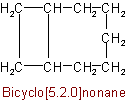
Examples to Rule A-1.21.3 - Unsaturated hydrocarbons are named in accordance with the principles set forth in Rule A-11.3 When after applying Rule A-1.2 a choice in numbering remains unsaturation is given the lowest numbers.
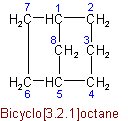
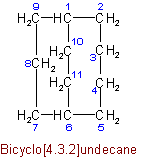
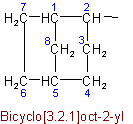
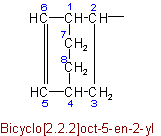
Examples to Rule A-1.31.4 - Radicals derived from bridged hydrocarbons are named in accordance with the principles set forth in Rule A-11 The numbering of the hydrocarbon is retained and the point or points of attachment are given numbers as low as is consistent with the fixed numbering of the saturated hydrocarbon.
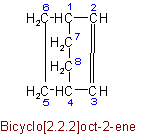
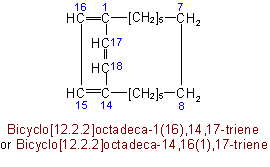
(See Rule A-.1 for double locants)
Examples to Rule A-1.4


 can be quite complex, there is typically one rate-determining enzymatic step that allows this reaction to be modelled as a single catalytic step with an apparent unimolecular rate constant kcat. If the reaction path proceeds over one or several intermediates, kcat will be a function of several elementary rate constants, whereas in the simplest case of a single elementary reaction (e.g. no intermediates) it will be identical to the elementary unimolecular rate constant k2. The apparent unimolecular rate constant kcat is also called turnover number and denotes the maximum number of enzymatic reactions catalysed per second.
![v_0 = \frac{V_\max[\mbox{S}]}{K_M + [\mbox{S}]}](http://upload.wikimedia.org/math/9/e/8/9e887f652080baeae3236523f4316445.png) (Michaelis–Menten equation)
(Michaelis–Menten equation) ![\begin{align}
K_M \ &\stackrel{\mathrm{def}}{=}\ \frac{k_{2} + k_{-1}}{k_{1}} \approx K_D\\
V_\max \ &\stackrel{\mathrm{def}}{=}\ k_{cat}{[}E{]}_{tot}
\end{align}](http://upload.wikimedia.org/math/7/c/c/7cc86c5f51e917dfb3b517c937089935.png)
![d{[}ES{]}/{dt} \; \overset{!} = \;0](http://upload.wikimedia.org/math/0/8/f/08f59e2b77fc9b255da74af77b16dc0a.png) . The second assumption is that the total enzyme concentration does not change over time, thus
. The second assumption is that the total enzyme concentration does not change over time, thus ![{[}E{]}_\text{tot} = {[}E{]} + {[}ES{]} \; \overset{!} = \; \text{const}](http://upload.wikimedia.org/math/4/6/6/4667651f6f6d82a0c5bef9130f3af073.png) . A complete derivation can be found here.
. A complete derivation can be found here. ), the Michaelis constant KM is roughly the dissociation constant KD of the ES complex.
![[S] / (K_M + [S]) \approx [S] / K_M](http://upload.wikimedia.org/math/7/0/7/7071e21a580398420d8e6bd0673ea3df.png) and also very little ES complex is formed, thus
and also very little ES complex is formed, thus ![[E]_0 \approx [E]](http://upload.wikimedia.org/math/0/f/9/0f92ba855b6682e83c7195e3899887be.png) . Therefore, the rate of product formation is
. Therefore, the rate of product formation is![v_0 \approx \frac{k_{cat}}{K_M} [E] [S] \qquad \qquad \text{if } [S] \ll K_M](http://upload.wikimedia.org/math/8/7/2/87214feb1ac3e7a5919b4e60a9ed3ddb.png)